Eat / The one dish you will actually remember
Hot dry noodles.
Wuhan eats standing up.
Every city in China has a noodle it calls its own. Wuhan's is regan mian (热干面, 'hot dry noodles') — alkaline noodles tossed in sesame paste, no soup, sold from stalls before dawn and eaten on the move. It is the dish this city thinks in.
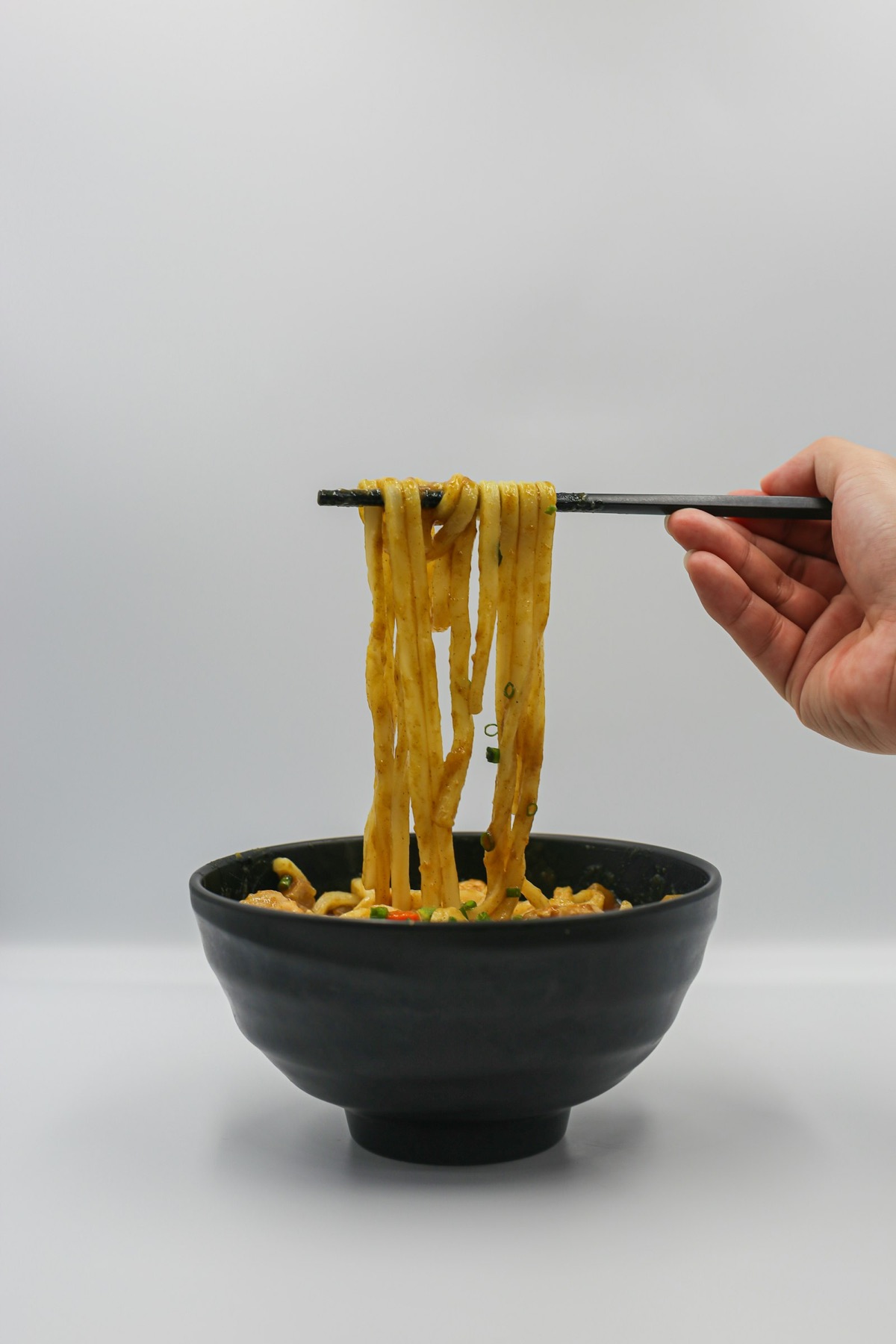
Regan mian is Wuhan's signature dish: yellow alkaline noodles blanched for seconds, then coated in black sesame paste with pickled radish, chopped long beans and scallions — dense, glossy and deliberately soup-less. It anchors guòzǎo (过早), the breakfast ritual that gives the city its 'breakfast capital' nickname. A bowl costs about ≈$0.60–1.20¥4–8 — Reported by secondary sources; verify on site. at a neighbourhood stall and ≈$1.79–2.69¥12–18 — Reported by secondary sources; verify on site. at the famous old-brand chains. Two things first-timers should know: it must be eaten hot within roughly three minutes or it clumps, and it is not spicy unless you ask for chili oil.
You will smell it before you see it: roasted sesame, hot off the ladle, drifting down a lane at seven in the morning. This page is the deep dive on the dish — what it is, where it came from, how to order it, and the one mistake that ruins it. The wider food picture lives on the eating page.
What the bowl is
The noodles are wheat with baked soda (碱面), which gives them their yellow tint and springy bite. They are cooked most of the way the evening before, tossed in oil and left to cool — the step that makes a thirty-second assembly possible at dawn. At the stall they spend roughly ten seconds in boiling water, land in a paper bowl, and get dressed: black sesame paste thinned with sesame oil, soy, pickled radish dice, sour long beans, scallions. Chili oil is at the counter, by choice. The result is unlike any noodle soup you have had — dry in the way good pasta is dry, everything clinging to everything.
The legend, and the paper trail
The trail starts in print: a Qing-dynasty verse collection about Hankou, the Hankou Zhuzhi Ci, already describes a breakfast scene of 'cut noodles, bean threads and dry rice noodles' — cut noodles being the ancestor of today's dish. The origin story everyone tells is a legend, and the tellings disagree on the decade: a Hankou noodle peddler named Li Bao, left with unsold cooked noodles overnight, accidentally splashed sesame oil over them, blanched them the next morning, and found the result better than what he had been selling. Stories place it anywhere from the 1910s to the 1930s.
What is documentable: the Cai Linji brand traces itself to 1928, when founder Cai Mingwei refined the oil-tossing technique and made sesame paste the soul of the dish; the name 热干面 was fixed in the 1950 business registration; the craft entered Hubei's provincial intangible-heritage list in 2011 and the national list in 2021; and the dish regularly appears on China's best-known noodle rankings, including a widely cited 'five famous noodles' list (reported). The old counter at the Cai Linji shop, and smaller temples of the dish like Xiong Lasheng's 1982 stall that still sells hundreds of bowls a day, keep the same formula: noodles first, paste second, speed always.
过早: the ritual around it
In Wuhan, breakfast is not a meal category, it is a verb — 过早, guòzǎo, 'passing the morning'. The food writer Chua Lam called Wuhan a breakfast capital, and locals claim you could eat a different breakfast for a month without repeating. The claim is folklore-flavoured, but the variety is real: regan mian anchors a cast of doupi (egg-skinned glutinous rice wrap), mianwo (a deep-fried rice ring), hutang fen (a thick fish-paste soup with noodles), and egg wine (蛋酒, fermented rice with a stirred-in egg) to wash the sesame down. People eat standing at the counter, walking to the bus stop, sometimes cycling. Nobody will look at you twice for doing the same.
How to order and eat it
- Say the sentence一碗热干面 (yī wǎn rè gān miàn) — 'one bowl of hot dry noodles'. At most stalls that is the whole menu decision. Want chili: 加辣 (jiā là). Pointing works everywhere.
- Mix immediatelyThe paste sinks. Get the chopsticks to the bottom and turn the bowl over on itself until every strand is coated — the local standard is 'root by root'. This is the step people rush and regret.
- Beat the three minutesHot dry noodles have a golden window: eat them while they are hot and loose, or the soda noodles seize into a clump. Do not photograph it for two minutes first. The bowl is also a walk-with item — joining the street traffic with your bowl is the authentic move.
- Order the partnerA bowl of egg wine or soy milk cuts the sesame richness; a mianwo on the side is the classic. Soup drinkers, manage expectations: there is no broth, and that is the point.
What a bowl costs — and where to eat it
Neighbourhood stalls and community shops run about ≈$0.60–1.20¥4–8 — Reported by secondary sources; verify on site. a bowl; the famous chains such as Cai Linji charge roughly ≈$1.79–2.69¥12–18 — Reported by secondary sources; verify on site.; inside tourist strips, sets climb higher still. Prices float and there is no official menu, so treat all of it as ballpark. The honest local answer to 'which shop is best' is 'the one downstairs from my flat' — the dish is a daily habit, not a pilgrimage. As a visitor: pick a stall by crowd logic (electric bikes parked outside at 07:00 is the Michelin star of guòzǎo), or try Cai Linji once for the institution it is, then spend the rest of your mornings in ordinary lanes. The famous snack street is a separate decision — our honest take on Hubu Alley.
This is a heavy, dry, high-gluten breakfast built for dock workers — dense carbs and sesame paste, no soup to soften it. If your stomach wants gentle on a travel day, split a bowl and pair it with soy milk or egg wine. And if you linger too long over the photo, you will be eating clumped noodles; the dish genuinely does not wait.
Questions we keep seeing
What do hot dry noodles (regan mian) taste like?
How much does a bowl of hot dry noodles cost?
Where should a first-timer eat hot dry noodles in Wuhan?
Is regan mian spicy?
Sources, prices and currency
History and ritual: Wuhan municipal government portal reprint of China News Service (2022-12-07), China Writers Network (2024-01), Hubei Provincial Library folklore pages, Cai Linji official site (brand dates), Baidu Baike (1950 registration; origin-story variants). National ICH listing 2021 is multi-source but the State Council list was not read directly. Prices are platform/community snapshots from 2026 (F79), reported and floating — no official menu exists. The Li Bao origin story is presented as legend; sources disagree on the decade. Per-plate consumption figures circulate but fail our sourcing bar and are deliberately omitted. Class B. Official sites for places named on this page: Hubei Provincial Museum. See the full official-site index for every venue we mention.
Every CNY amount on this page is shown twice: the yuan figure you will actually see on the price board, and a US dollar conversion for budgeting. Dollar values are mid-market conversions at 1 CNY = $0.14957 (ExchangeRate-API (open.er-api.com), 12 Nov 2026), refreshed automatically when the page loads and cached for 24 hours. Your bank or card issuer will use its own rate and may add a foreign-transaction fee. Full explanation.
Checked quarterly — hours, routes and venues. This page was last checked 2026-11.