Plan / Choosing a route
Pick a route,
not a checklist
Wuhan is three towns split by two rivers. A good day here is not the one with the most sights in it; it is the one with the fewest river crossings. The city publishes plenty of official routes, but they are holiday products that change every year — so we show you what those documents actually say, then give four routes built around the geography that does not change.
There is no permanent official 'classic Wuhan route'. The city publishes seasonal themed routes for holidays, not a standing one. Four combinations work reliably: one day split between Wuchang and Hankou, two days adding East Lake, three days adding the museum, or a single themed day. Cross the Yangtze once per day, not three times.
This page helps you choose a route. It is not a list of sights — that is See and do — and it does not repeat the hour-by-hour tables in Three days in Wuhan or the tight clock in A layover in Wuhan. Anything outside the city goes to Side trips. What is left here is the decision that actually costs you time: which bank to be on, and when to cross.
First, what the city actually publishes
Searched across 2023–2026, there is no standing, officially designated "classic Wuhan itinerary". What Wuhan's municipal and provincial tourism authorities do publish are seasonal, thematic and city-walk lines tied to a holiday, a gala or a campaign. Two consequences matter for a visitor: they expire, and several of them exist only as a list of names with no stops or timings attached.
| When | What was published | What you actually get |
|---|---|---|
| Sep 2023 | 10 city-walk routes (Wuhan Culture and Tourism Bureau) | Names and short descriptions only — no stops, no durations |
| Jan 2023 | 15 provincial Spring Festival routes, including a Wuhan city line | A named Wuhan line with example points |
| Mar 2024 | Business and technology routes explicitly aimed at overseas visitors | Four sub-routes plus an Optics Valley line; a niche product |
| Jan 2025 | Three "follow the Spring Festival Gala" themes | Full point-by-point sequence; the culture line links East Lake, the museum, the tower and the bridge |
| Jun 2025 | Five intangible-heritage themes, ten routes, 50-plus sites | Theme names and a site count — the ten individual routes are not itemised on the page |
| Sep 2025 | Ten National Day quality routes, plus metropolitan-area lines | The most useful document: several routes are given day by day with their stops |
We do not invent the missing stops. Where an official page gives only a theme name, this table says so. The links are collected at the foot of this page.
The September 2025 "night" route runs D2 from Liangdao Street to the Yellow Crane Tower, Tanhualin, the First Yangtze Bridge, the Zhiyin cultural area, Qingchuan Pavilion and Lanjiang Road — one crossing, Wuchang to Hanyang. Its "Yangtze" route moves from Wuchang waterfront streets to the Hankou bund, Jianghan Road and Lihuangpi Road — again one crossing. Even the city's own packed holiday itineraries rarely cross the river twice in a day. That is the constraint worth planning around (F98a).
Four routes we would actually use
One day: Wuchang old town, then Hankou at dusk
The single most efficient day in the city. Start in Wuchang with the Yellow Crane Tower and the First Yangtze Bridge while the light is still low, walk the Tanhualin slope or the 1911 museum, and eat breakfast or lunch on a residential street rather than in a tourist lane. Then take the ferry from Zhonghua Road to Wuhan Guan — it lands you beside the customs house, Jianghan Road and the Hankou bund, which is exactly where you want to be at dusk.
Read next: the breakfast guide · the cheap public crossing · what to look at on the far bank
The catch: a one-day plan has to give up East Lake and a proper museum visit — an English one-day guide we checked says exactly that. The public ferry stops running at 20:00, so a late dinner on the wrong bank means a metro or taxi back (F99, F100).
Two days: add East Lake and the provincial museum
The best ratio of effort to reward. Keep day one as above, then give day two to the lake and the museum, which sit on the same side of the river and share a neighbourhood. This is the combination that most English and Chinese two-day plans converge on, and it is the shortest visit in which Wuhan stops feeling like a transit stop.
Read next: museum booking and what is inside · the lake · the three stations if you arrive by rail
The catch: the museum needs a real-name reservation and we could not verify its detailed opening rules on its own site, so check the official museum page before you build a day around it. We do not publish a "closed Mondays, book three days ahead" claim on the strength of travel-agency guides alone (F101).
Three days: one town per day
Three days is not "more sights", it is the same sights with the crossings spread out. Day one Hankou's concession-era streets and riverfront, day two Wuchang's old town and the bridge, day three East Lake, the museum and the university area. Five Chinese and English plans we compared independently arrive at this same three-part split, which is a decent signal that the geography is doing the deciding.
Read next: the full hour-by-hour version · is three days too many?
The catch: do not count your arrival or departure day as a full day, and do not bolt on a side trip to the Three Gorges in the same three days — that belongs on the side-trips page and needs its own time.
One themed day: blossom, breakfast, concession buildings or bridges
A theme is a better use of a spare day than a fourth famous building. Four themes have real official backing: the cherry-blossom season (the city and local press publish a dated blossom forecast and name the recommended spots), a breakfast morning (heritage routes name the old snack houses), the treaty-port streets (heritage routes list the individual lanes and buildings), and the bridges (a dedicated official route plus our own one-by-one guide).
Read next: blossom season · breakfast streets · the bridges, one by one · official blossom forecast points
The catch: blossom is a March window with a new forecast each year — there is no fixed date to plan a flight around. "Three Kingdoms" is not a city route: the official itineraries put the Red Cliffs sites in neighbouring prefectures. And the river light show has published festival-only schedules, not a permanent nightly one (F101).
Why the river decides everything
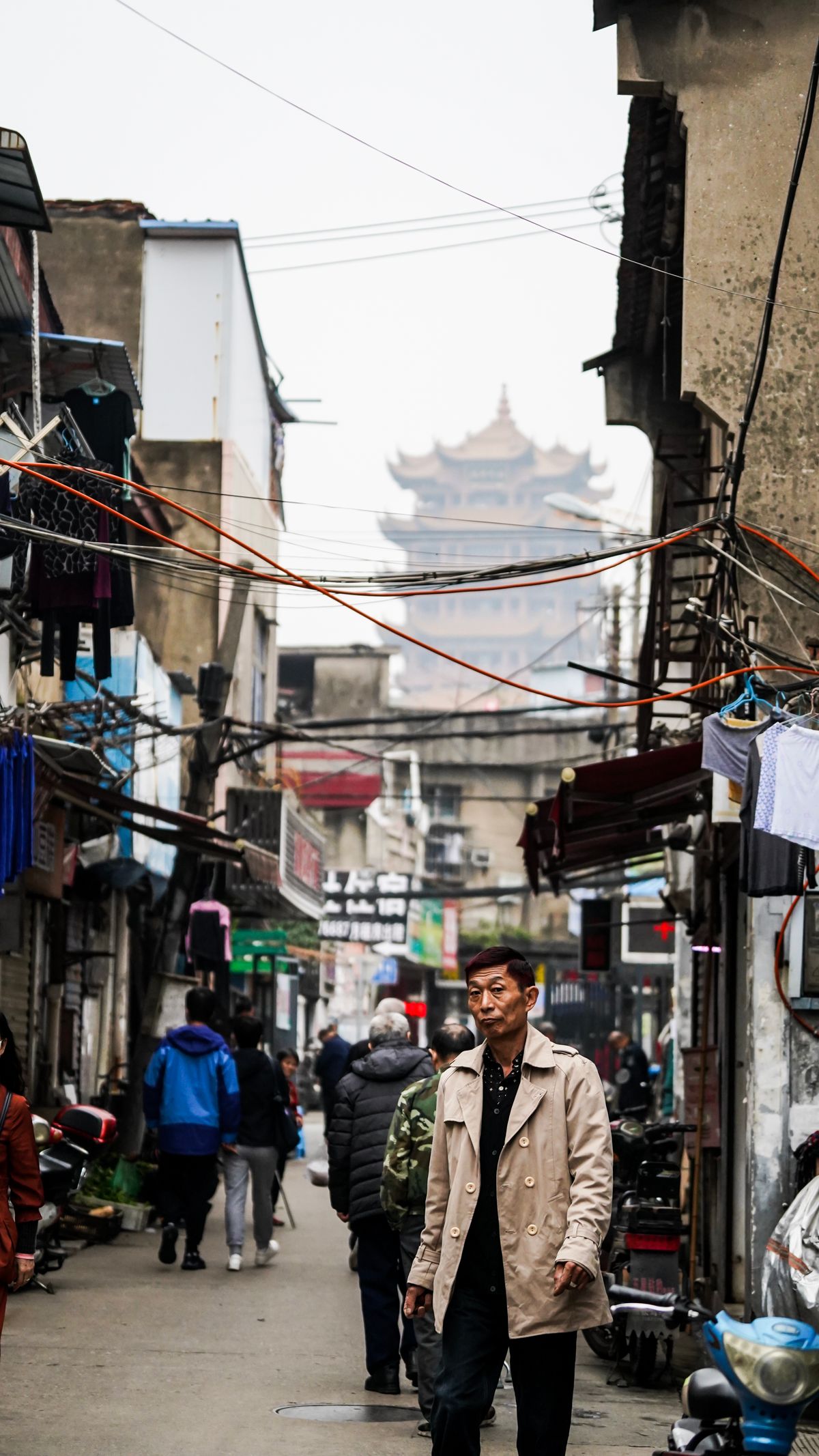
Wuhan's own transport authority describes the city as "three towns separated by two rivers", and lists four metro sections that cross the Yangtze. The cheap public ferry links Zhonghua Road in Wuchang to Wuhan Guan in Hankou, costs $0.22¥1.5 — Official / verified figure. and runs 06:30–20:00 with more frequent departures at peak times. That is the whole logic of a good route: put the same-bank sights together, then use one crossing as a transition rather than as a commute you repeat.
| Line | River-crossing section | Useful for |
|---|---|---|
| 2 | Jiyuqiao ↔ Jianghan Road | The direct link between the Hankou shopping district and Wuchang old town |
| 4 | Fuxing Road ↔ Lanjiang Road | Wuchang to Hanyang |
| 7 | Xujiapeng ↔ Sanyang Road | Wuchang to Hankou |
| 8 | Xujiapeng ↔ Huangpu Road | Wuchang to Hankou |
We publish the fare and the operating window because both come from an official source. Journey times such as "15 minutes on the ferry" or "20 minutes from Wuhan Station to the tower" circulate widely but are estimates, not published service data, so they are not used as planning numbers here.
Combinations that look fine on a map and are not
Five headline sights in one day
Yellow Crane Tower + the provincial museum + East Lake + the Hankou bund + Guiyuan Temple means repeated crossings and two half-days indoors. The city's own holiday routes keep each day to one bank or one crossing.
Too many crossingsScheduling a night river cruise by guesswork
Commercial evening boats are products, not an official route, and published light-show times are festival-specific. We do not list prices or promise a nightly show.
No standing timetableTreating a holiday route as permanent
A National Day or Spring Festival line is a dated campaign. It may not run, and its stops may be staged for that week only.
Seasonal by designBuying a "Wuhan in a Day" package as the official line
Those are commercial tours. We link to government pages, not booking engines, and take no commission.
Commercial ≠ official
One honest disagreement
Chinese traveller guides will often tell you to skip Hubu Alley as a place to eat, and to go to a residential breakfast street instead. That is reasonable advice and it matches our own Hubu Alley page. But we will not dress it up as an official position: a 2023 provincial route and a January 2025 municipal route both include Hubu Alley, while the September 2025 municipal routes use Liangdao Street, Dacheng Road, Shuiliu Street, Shanhaiguan Road and Shanglong Road for breakfast instead. The same institution publishes different answers in different years. We report that rather than picking a winner.
Every official route on this page is a dated campaign product, and the useful ones are written for domestic holiday crowds, not for a first-time visitor with luggage and a foreign payment app. We have deliberately left out ticket prices, blossom dates, ferry journey times, museum reservation quotas and light-show schedules because we could not verify them from a primary source. This page tells you which bank to be on; for the current numbers, use the linked official pages on the day. Class B: the route releases and the ferry service details need a quarterly re-check.
The documents, so you can check us
Wuhan municipal government
Ten National Day routes, 2025 · Spring Festival Gala routes, 2025 · Intangible-heritage route themes, 2025 · City-walk route names, 2023
Official, ChineseProvince and city bureaus
Hubei Spring Festival routes, 2023 · Routes aimed at overseas visitors, 2024 · Metropolitan-area classic routes, 2025
Official, ChineseThe transport facts
Four metro crossings of the Yangtze · Public ferry fare and operating hours, 2026
OfficialEnglish comparisons
A commercial one-day route, read for comparison · China Daily's Wuhan day one
Not official routesQuestions we keep seeing
Is there an official classic Wuhan itinerary?
How many days does Wuhan need?
Why does crossing the river matter so much?
Should I follow the city's published holiday routes?
Is Hubu Alley officially recommended or officially dropped?
Can I see Wuhan in a few hours between flights?
Sources, prices and currency
Official route releases, their dates and their limits follow FACTS F98; the two day-by-day 2025 National Day sequences are F98a. The river-crossing metro sections, the public ferry fare and its 06:30-20:00 operating window are F99 (Wuhan Transport Bureau; People's Daily Hubei, May 2026) — the fare is rendered through the site's dual-currency component. English and Chinese itinerary comparisons and the Hubu Alley disagreement are F100 / F100a; theme evidence grading is F101. We publish no ticket prices, blossom dates, ferry journey times, museum reservation quotas or light-show schedules because no primary source was found for them; those exclusions are listed in the F101 discipline note. All outbound links are held in data/reference-links.json and expanded at build time. The three photographs are Pexels editorial images listed in data/image-credits.json; only one is identified by its listing as Wuhan, and none is a route map. Class B: re-check the route releases and ferry details quarterly. See the source method.
Every CNY amount on this page is shown twice: the yuan figure you will actually see on the price board, and a US dollar conversion for budgeting. Dollar values are mid-market conversions at 1 CNY = $0.14957 (ExchangeRate-API (open.er-api.com), 12 Nov 2026), refreshed automatically when the page loads and cached for 24 hours. Your bank or card issuer will use its own rate and may add a foreign-transaction fee. Full explanation.
Checked quarterly — hours, routes and venues. This page was last checked 2026-11.