Take part / The zhiyin story
The Guqin Terrace and the zhiyin story
Wuhan's most distinctive contribution to Chinese culture is a friendship story — and one of its musical artifacts has left the solar system.
The Guqin Terrace commemorates China's founding friendship story: the zither master Boya, the woodcutter Ziqi who truly heard his music, and the word zhiyin — the friend who hears you — that still names soulmates in Chinese. Go for the story and live guqin, not for antiquity: the buildings are post-1949 rebuilds on an older site in Hanyang.
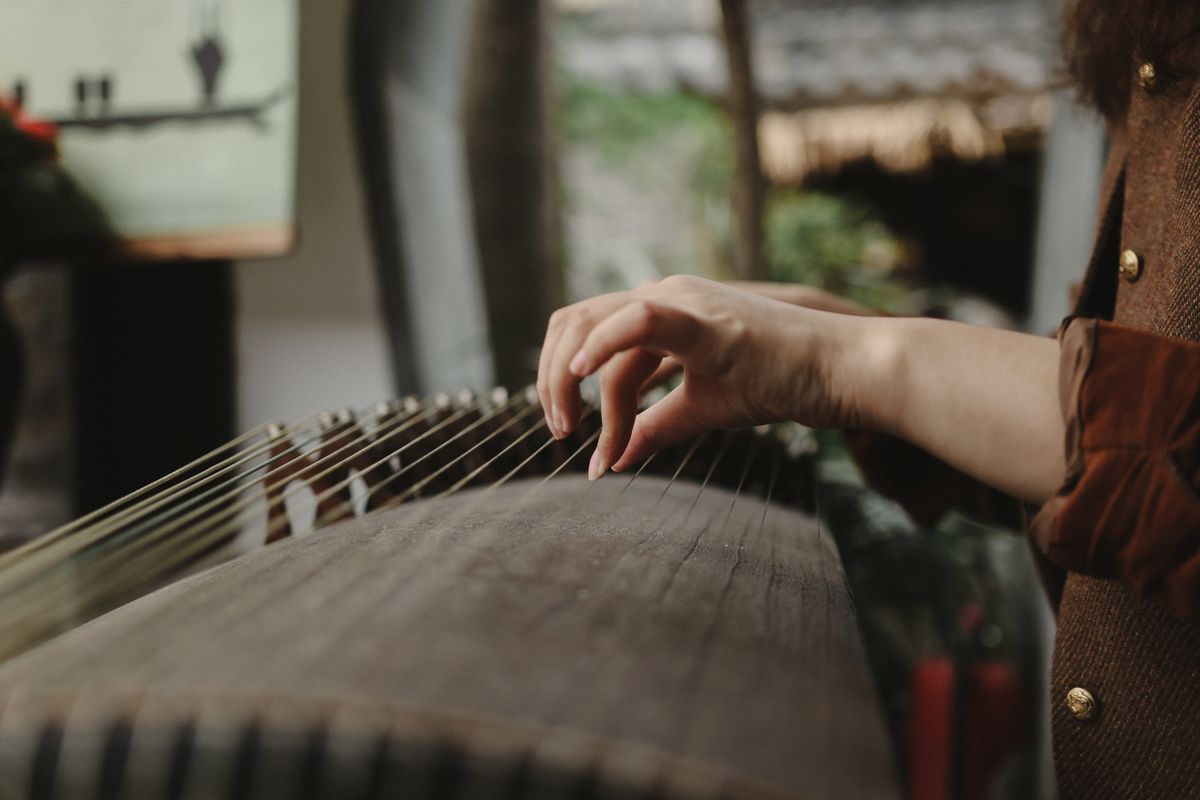
Boyhood legend, national vocabulary. The qin master Yu Boya played by the river; the woodcutter Zhong Ziqi heard pines and mountains in the music and knew exactly what Boya meant. When Ziqi died, Boya smashed his qin and never played again — no one else would hear him. From this the Chinese language took the word zhiyin (知音), "the one who knows the sound", still the standard term for a soulmate or a critic who truly gets your work. Every Chinese visitor to this terrace knows the story; now you do too.
What is actually there
Manage expectations before you go. The terrace is a provincial protected site called "the first terrace of zhiyin under heaven", but the structures standing today were rebuilt after 1949 and refreshed again in 2024 (F118). The two characters "琴台" over the gate are attributed — attributed, the guidebooks say 相传 — to the Song calligrapher Mi Fu. And the rating needs care: the Hanyang district register lists Guqintai itself as 3A; the 4A rating you may see quoted belongs to the wider Zhiyin Culture Tourism Area, a 2025 combination of the terrace, Qingchuan Pavilion, Tortoise Hill and Moon Lake (F118, F45). Neither fact ruins the visit; both belong in it.
Hearing the guqin there
This is the reason to go beyond the story. The city's federation of trade unions reports that the terrace's qin hall has kept up daily guqin performances without interruption, four sessions a day, including "Flowing Streams" — the very piece of the legend — and that seasonal gatherings follow the solar terms (F118). That is a B-level source, not the terrace's own site, so we report it rather than promise it: check the day's sessions on arrival. The guqin itself — seven strings, no bridges, quieter than any concert instrument — was proclaimed a UNESCO masterpiece of oral and intangible heritage in 2003, and this terrace is one of the few places a traveller stumbles into it live.
The space-travel hook
When NASA assembled the Voyager Golden Record in 1977 — humanity's mixtape for whatever might find it — the Chinese track was "Flowing Streams" (Liu Shui), played on the guqin by Guan Pinghu, listed at 7 minutes 37 seconds (F118, F49; the NASA tracklist page resisted our direct fetch, so that credit rests on search records and authoritative Chinese coverage — flagged for re-check). A Wuhan story, played on the instrument this terrace honors, now beyond the heliosphere. Few city legends travel further.
Nothing here is ancient, performances are reported rather than published on a schedule, and English interpretation on site is thin — Wuhan's own 2012 signage guidelines were drafted in a week, and the terrace's sign has been caught in print as the nonsensical "Boya Terrace" (F118). Go for the story, the quiet, and the music if it happens; keep the forty minutes you would otherwise budget for a monument.
Putting it in a day
The terrace faces Moon Lake, and the Qintai arts quarter — the concert hall and Grand Theatre — is the same waterfront, built on the legend's theme ("high mountains and flowing water"). So the natural pairing is cultural and literal: terrace, lake walk, and if the programme cooperates an evening concert (how to book the halls). Guiyuan Temple with its counting-the-luohans custom is also in Hanyang, one metro stop of planning away.
Questions we keep seeing
Is the Guqin Terrace a 4A attraction?
Will I actually hear guqin music there?
Is the story of Boya and Ziqi history or legend?
What is the difference between a guqin and a guzheng?
How much time should I give it?
Sources, prices and currency
Site status (3A single site vs 4A combined area), post-1949 rebuilding, Mi Fu attribution and the daily-performance report: Hanyang district government and Wuhan Federation of Trade Unions pages (F118). Voyager Golden Record credit (Guan Pinghu, "Flowing Streams", 7:37): search records and Chinese authoritative coverage; NASA's own tracklist page resisted direct fetch and is flagged for re-check (F118, F49). UNESCO 2003 proclamation: state English-language reporting (B). Class C — re-check yearly.
Every CNY amount on this page is shown twice: the yuan figure you will actually see on the price board, and a US dollar conversion for budgeting. Dollar values are mid-market conversions at 1 CNY = $0.14957 (ExchangeRate-API (open.er-api.com), 12 Nov 2026), refreshed automatically when the page loads and cached for 24 hours. Your bank or card issuer will use its own rate and may add a foreign-transaction fee. Full explanation.
Checked yearly — geography, history and background. This page was last checked 2026-11.